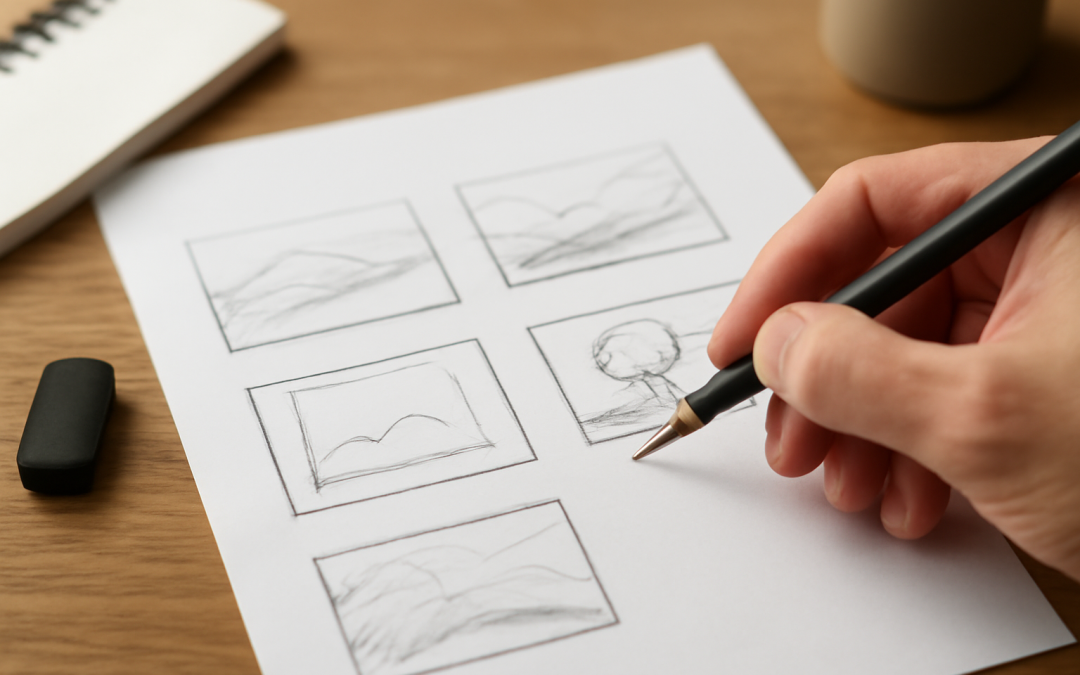
In the early stages of a creative project, capturing ideas swiftly and effectively is crucial for developing a solid foundation. This is especially true in visual design disciplines, where quick conceptual visualization can clarify the direction of the entire endeavor. Thumbnail sketching methods serve as fundamental tools in this initial phase, providing designers, illustrators, and artists with a way to explore a wealth of ideas without committing to detailed or time-consuming work. These small-scale drawings allow for rapid experimentation, enabling creators to iterate and refine their concepts before moving to more polished stages.
At its core, thumbnail sketching is about speed and efficiency. These sketches are typically small, no larger than a few inches on each side, created with minimal detail but encompassing the big picture. The method encourages focusing on composition, form, and layout rather than on intricate lines or precise rendering. By simplifying the process, it helps overcome the intimidation often associated with a blank canvas. Thumbnail sketches become visual notes, translating abstract concepts into tangible forms quickly, which encourages more free-flowing creativity.
Various thumbnail sketching methods have emerged over time, tailored to fit different creative needs and personal workflows. One widely practiced method involves drawing multiple thumbnails consecutively on a single page. This grid-like approach leverages quantity to generate a broad spectrum of options, each varying in composition, perspective, or subject matter. The advantage here lies in visual comparison; when presented side by side, it becomes easier to recognize which ideas resonate best or hold the most promise for further development. By fostering fast iteration, this technique helps guard against the trap of fixating on a single idea prematurely.
Another common method focuses on exploring value and contrast using thumbnail sketches. Since tone and light play an essential role in visual storytelling, quick studies that experiment with light, shadow, and overall composition balance can inform the mood and readability of the final piece. Artists often use markers, pencils, or charcoal to establish darks and lights, paying less attention to details and more to the overall tonal structure of the image. This approach is particularly beneficial for painters and illustrators working in mixed media, sculpture, or digital painting, where the manipulation of light is core to the design.
Many creatives prefer integrating thumbnail sketching directly into their brainstorming sessions. Rather than only relying on verbal description or mental conceptualization, transforming ideas into thumbnail sketches solidifies the intent behind decisions. This visual sketching method acts as a bridge between thought and execution, making intangible ideas visible and comprehensible. As a result, teams collaborating on projects can communicate ideas more effectively while bypassing verbose explanations. When multiple members contribute thumbnail sketches, a diverse range of concepts emerges, increasing the likelihood of discovering innovative approaches.
Some designers employ gesture drawing as a thumbnail sketching method. Gesture sketches are typically fluid and loose, capturing only the essence of the subject’s movement or pose. This technique is especially useful for character designers, animators, and illustrators focused on storytelling through dynamic figures. By prioritizing motion and energy, gesture thumbnails provide a robust foundation that animators or figure artists can later refine with anatomical accuracy or expressive detail. The approach simultaneously enhances both speed and expressiveness, pushing creators to capture the spirit of a scene rather than its minutiae.
Digital tools offer additional dimensions to thumbnail sketching methods. Using tablets and styluses, artists can quickly toggle between brush sizes, undo mistakes, and layer compositions, all of which accelerates experimentation. Many digital art programs also facilitate the creation of multiple thumbnails on virtual canvases, making organization and editing seamless. Moreover, the portability of digital devices encourages sketching anytime inspiration strikes. While the tactile feedback of paper still holds value for many, the flexibility and accessibility of digital thumbnails are undeniable advantages in contemporary practice.
When working on complex projects such as book covers, advertisements, or user interfaces, thumbnail sketching methods often involve iterative refinement. A rough thumbnail might be scanned or photographed and then digitally enhanced to test typography placement or color schemes. In these instances, thumbnails serve as a testing ground that reduces risk by identifying potential compositional issues early. This process alleviates costly revisions later in the design timeline and ensures that fundamental problems are addressed before high-fidelity production begins. By anchoring development in solid thumbnail concepts, the final output tends to be more coherent and impactful.
Additionally, spatial composition is a key consideration within thumbnail sketching. Thoughtful arrangement of elements within a limited frame can significantly influence viewer engagement and narrative clarity. Thumbnail sketches help clarify the relationship between foreground and background, negative space, and focal points. Experimenting with these spatial dynamics at a small scale encourages designers to think critically about hierarchy and movement within their work. For graphic designers and illustrators alike, mastering the interplay of space in thumbnails can lead to more compelling and balanced compositions.
In education and training environments, thumbnail sketching methods are frequently emphasized to hone observational skills and conceptual thinking. Students are often tasked with producing multiple thumbnails in a short period to encourage rapid ideation and discourage overthinking. This practice builds confidence and fluency in visual communication, enabling learners to distill complex ideas into concise visual summaries. By embedding these methods into curricula, instructors help cultivate a mindset that values exploration and iteration as much as technical skill, preparing students for real-world creative challenges.
While the primary focus of thumbnail sketching is on speed and concept over detail, the quality of execution still matters. A clear thumbnail communicates the core idea effectively, guiding the next stages of development. Sketches cluttered with indecipherable marks or lacking defined shapes can lead to confusion rather than clarity. This balance between looseness and legibility is a hallmark of skilled thumbnail sketching. Artists who master this equilibrium can produce sketches that inspire and inform without spending excessive time on refinement.
The context of the project also influences the choice of thumbnail sketching methods. For instance, concept artists working in entertainment industries like gaming or film often incorporate environmental and character thumbnails simultaneously, mapping out scenes and key story moments side by side. This integrated approach supports cohesive visual storytelling, aligning technical design with narrative goals. On the other hand, editorial illustrators may focus more on composition sketches that prioritize symbolic or metaphorical elements, capturing the essence of ideas in evocative ways.
It is important to recognize that thumbnail sketching methods are not constrained to a single artistic medium. While traditionally associated with drawing, sketches can include collages, photomontages, or digital mock-ups that function as visual thumbnails. The key characteristic remains their small size and snapshot quality, distilling complex ideas into their simplest form. This flexibility allows creatives to adapt sketching methods to accommodate diverse workflows and project demands, emphasizing utility over tradition.
The psychological benefits of thumbnail sketching are also notable. By externalizing thoughts rapidly, artists reduce mental clutter, facilitating clearer thinking and problem-solving. The process encourages a mindset of experimentation and resilience, where perceived failures are seen as stepping stones rather than setbacks. This iterative attitude supports sustained creativity and prevents stagnation during challenging stages of a project. As such, thumbnail sketching methods contribute not only to technical progress but to the emotional health of the creative practitioner.
Collaboration is another arena where thumbnail sketching proves invaluable. When creative teams share quick thumbnails during meetings or brainstorming sessions, feedback becomes concrete and actionable. Instead of relying on abstract descriptions, stakeholders can respond directly to visual proposals, making discussions more dynamic and productive. Furthermore, shared sketchbooks or digital platforms can centralize these thumbnails, preserving the project’s conceptual history and providing a resource for future inspiration or reference.
Although thumbnail sketching methods prioritize brevity and simplicity, it is possible to develop a personal style within this practice. Some artists favor extremely loose, scribbled thumbnails that evoke spontaneity, while others opt for cleaner, more graphic miniatures that resemble refined drafts. Experimenting with different approaches to line quality, shading, and page layout during sketches can lead to a unique visual language that carries throughout a creator’s body of work. Adopting a consistent yet flexible thumbnail methodology ultimately enhances both efficiency and artistic identity.
To maximize the effectiveness of thumbnail sketching, it is helpful to approach it as part of a structured workflow. Rather than treating it as a one-off activity, integrating thumbnails into each stage of pre-production ensures that ideas evolve logically and cohesively. For example, beginning with loose, rough thumbnails to explore multiple concepts, then selecting and enlarging promising options for further study, helps maintain momentum and clarity. This tiered process allows creators to harness the strengths of thumbnail sketching while bridging the gap to more detailed, finished pieces.
Time management is another dimension where thumbnail sketching methods excel. Because these sketches are designed to be quick and small, they allow practitioners to generate multiple options even under tight deadlines. This rapid output can be invaluable in professional settings where meeting client demands and project milestones is critical. By reducing the pressure to perfect initial ideas, thumbnails facilitate a focus on solution-finding rather than perfectionism, often leading to more innovative and effective designs.
Some professionals incorporate external references into their thumbnails as a way to blend inspiration with originality. By annotating sketches with notes or thumbnails that relate to existing works, designers remind themselves of stylistic influences, thematic considerations, or technical approaches worth exploring. This hybrid method encourages a dialogue between personal creativity and external stimuli, enriching the conceptual landscape from which the final work emerges.
In summary, thumbnail sketching methods are more than just preliminary doodles; they are powerful tools that shape the trajectory of creative projects across many disciplines. Their emphasis on speed, iteration, and clarity helps artists and designers navigate the complex path from vague ideas to concrete visuals. Whether through multiple quick studies, tonal experiments, gesture sketches, or digital applications, the strategic use of thumbnails enhances both individual creativity and collaborative workflows. Mastering thumbnail sketching thus unlocks a higher level of creative efficiency, allowing ideas to flourish and refine with both precision and flexibility.
Understanding the importance of these small, rapid sketches as integral steps rather than optional extras can transform the creative process. They serve as a visual playground where ideas are tested, refined, and sometimes discarded without consequence. This openness fosters a richer exploration of possibilities, leading to stronger, more compelling outcomes. By embracing effective thumbnail sketching methods, creators equip themselves with a versatile strategy for problem-solving and innovation that supports artistic growth and project success alike.