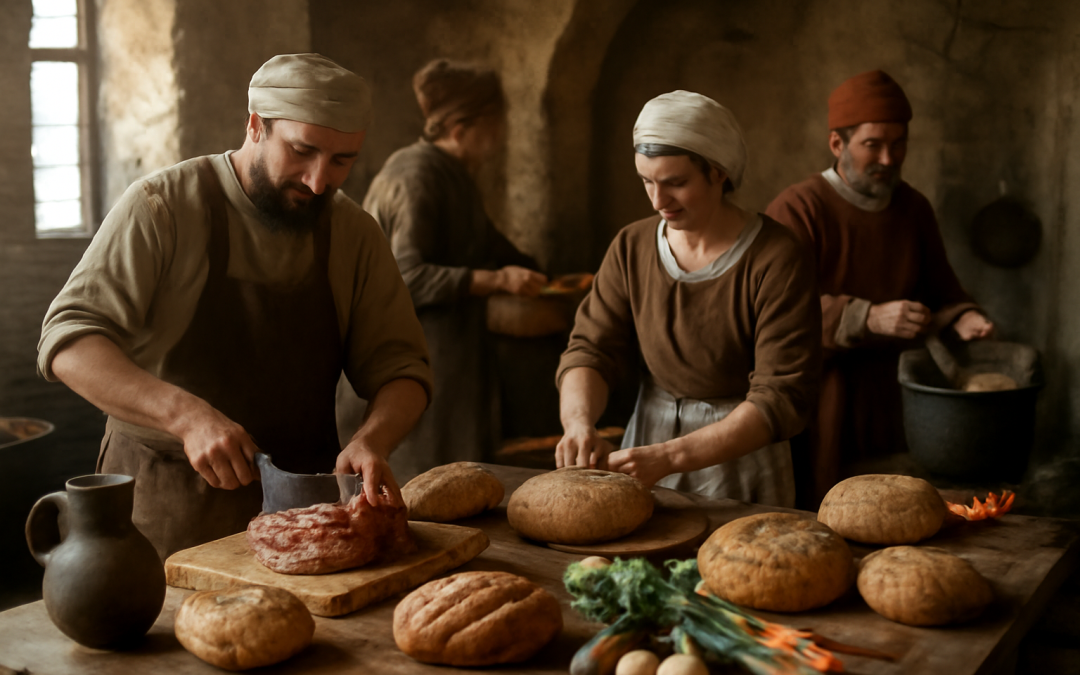
In medieval Europe, the production, distribution, and regulation of food were under the control of specialized organizations commonly known as food guilds. These guilds played a crucial role in the urban economy and social structure, acting as regulators of quality, price, and trade practices while also serving as protective bodies for their members. The intricate system of food guilds developed over centuries, reflecting the complexities of medieval life where food was not only a necessity but also a marker of social status and cultural identity.
Food guilds emerged primarily in the growing towns and cities where the demand for a steady and safe supply of food products was high. These guilds encompassed producers such as bakers, butchers, millers, and fishmongers, who banded together to control the standards of their craft. Membership in a guild was a rigorous process that often required years of apprenticeship and mastery before a craftsman could become a full member or ‘freeman’ of the guild. This system ensured that the food products offered to the public met certain standards, preventing unscrupulous practices and selling of substandard goods.
One of the most important roles of the food guilds was the regulation of quality and price. Medieval cities lacked modern food safety and quality controls, so guilds effectively acted as early consumer protection agencies. They established strict guidelines on how products should be made, stored, and sold. For instance, bakers’ guilds dictated the proportions of flour and water, ensuring that bread was neither too heavy and stale nor improperly baked. Butchers had regulations on how animals should be slaughtered, inspected, and how meat was to be displayed and sold. Violations could result in fines, loss of guild membership, or public humiliation. This system helped maintain public trust and prevented food crises stemming from poor quality or adulterated goods.
Beyond quality control, food guilds wielded significant economic power through their control of supply chains and pricing. By limiting the number of guild members, they effectively controlled competition, allowing for stable prices that benefited all members. This often meant that guild members held monopolies within city or town limits, with outsiders barred from selling food products within these areas. While this limited consumer choice, it also stabilized the markets and protected local producers from the volatility of supply and demand, which could cause prices to fluctuate wildly.
The social aspect of food guilds cannot be overlooked. Membership conferred not only economic benefits but also social prestige and political influence within the community. Many guilds functioned as social clubs and religious fraternities, holding regular meetings, festivals, and feasts. They often sponsored charitable works such as providing food for the poor or funding church activities. This charitable dimension helped guilds cement their position within the broader social fabric of medieval urban life. Moreover, guild leaders frequently participated in town councils, influencing municipal policies that affected trade and economic development.
Medieval food guilds were also instrumental in shaping the culinary culture of the time. The expertise and standards they maintained contributed to the development of regional specialties and traditional recipes. For example, the fishmongers’ guild regulated the sale of herring, a staple in many northern European diets, ensuring that only the finest salted fish was available. Similarly, millers guarded the quality of flour, a fundamental ingredient for bread and pastries, impacting the overall quality of baked goods across regions. These guilds fostered a sense of pride in local foods, which persisted through culinary traditions that are still recognized today.
The influence of food guilds extended to the intricate web of trade routes that connected medieval Europe. Many food products, such as spices, sugar, and dried fruits, were imported from distant lands via merchants who were often guild members themselves. The guilds regulated the importation and sale of these luxury items, controlling who had access to them and how they could be marketed. This not only preserved the exclusivity and high prices of luxury foods but also ensured their authenticity and purity. Without guild regulation, the market would have been prone to fraud and adulteration, which were common issues in medieval times.
Diving into the specific types of food guilds reveals a variety of distinct groups, each with its own set of rules and significance. The bakers’ guild, for example, was one of the most prominent due to the central role of bread in the medieval diet. They were responsible for ensuring that bread was made according to strict standards given its importance as a daily staple. In times of shortage or famine, bakers’ guilds sometimes coordinated with city authorities to ration bread, preventing exploitation by sellers. On the other hand, butchers’ guilds had the crucial task of maintaining hygiene standards in an era before understanding of germs. They supervised the entire process from slaughtering to sale, and in some cases, they even controlled the disposal of animal waste to minimize disease.
Fishmongers’ guilds held another vital place, especially in coastal towns where fish was a primary protein source. These guilds managed the fishing seasons, the distribution of catches, and even the preservation methods like salting or smoking. Owing to religious practices such as fasting days, where meat consumption was restricted, fish became indispensable, granting fishmongers significant economic and religious influence. Similarly, millers’ guilds, though less visible to common consumers, held control over a crucial step in the food production chain. They often had a monopoly over the milling of grain and were critical in supplying flour to bakers and households.
Spice merchants formed a unique subset that blended food guild functions with mercantile and international trade networks. Spices were the delicacies of the medieval diet, symbolizing wealth and luxury, as well as enriching otherwise bland meals. Guilds specializing in spices ensured the traceability and authenticity of their products, which were often expensive and highly susceptible to fraud. Their regulation ensured that the merchants maintained reputable standards in trading rare commodities sourced from the East, a factor that had implications for early global commerce and the eventual age of exploration.
The governance and rituals of food guilds reflected the hierarchical and religious nature of medieval society. Most guilds had a patron saint, and members participated in religious ceremonies and processions, which reinforced their collective identity and moral standing. Annual feasts allowed guild members to celebrate their trade and foster camaraderie. These events were also opportunities to demonstrate the guild’s wealth and influence. Elections within the guild placed prominent masters in leadership positions responsible for upholding a code of conduct and negotiating with city officials.
Despite their significant role, food guilds were not without criticism and conflict. Their monopolistic control often drew ire from consumers and non-members who were excluded from the market. Guild regulations could be rigid or resistant to innovation, slowing down improvements in food production or distribution. Additionally, the guild system was prone to corruption and nepotism, with certain families controlling guild leadership for generations. These issues sometimes sparked tensions within towns and led to reform attempts, especially as cities grew larger and more economically complex during the late medieval period.
The decline of food guilds began in the late Middle Ages and accelerated during the Renaissance with the rise of market economies and the increasing importance of free trade principles. The expansion of commerce, improvements in transportation, and centralization of political power gradually eroded the guilds’ monopolies and regulatory powers. Still, the legacy of medieval food guilds persisted in the ways they shaped culinary traditions, urban economies, and local governance. Their influence was a foundation upon which modern food regulation and professional standards eventually built.
Ultimately, the food guilds of medieval Europe represent a fascinating intersection of economy, culture, and social order. They maintained the balance between quality control and economic stability in a time when these were difficult to achieve. Their impact on the daily lives of medieval people was profound, not only in ensuring that communities had access to safe and reliable food but also in creating networks of trust and identity within rapidly growing urban centers. Understanding the role of these guilds offers valuable insights into the development of medieval society and the evolution of food systems that continue to shape our world today.