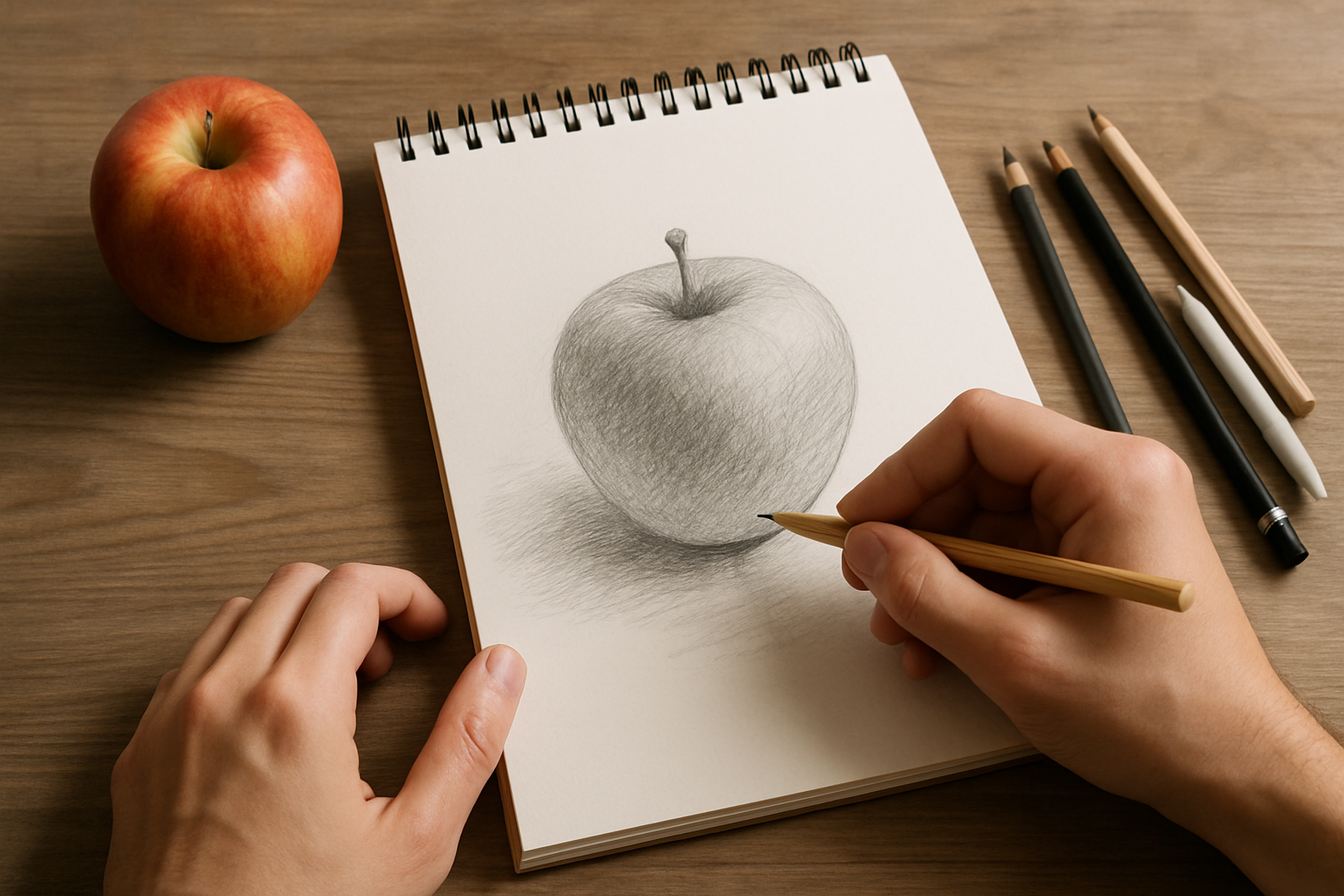
Observational drawing is a fundamental skill that bridges the gap between seeing and translating what one perceives onto paper. It involves closely examining a subject and capturing its essence through careful study, rather than relying on imagination or photographic references. Unlike drawing from memory or creativity alone, observational drawing requires discipline, patience, and acute attention to detail, making it an essential exercise for artists at any level who aim to sharpen their abilities and understand the world in a more profound way.
At its core, observational drawing is about training the eye to see accurately. This skill transcends mere technical ability; it fosters a deeper connection between the observer and their subject, cultivating an appreciation for form, light, texture, and proportion. The process begins with looking attentively—developing the habit of noticing subtle shapes, shadows, and spatial relationships that might otherwise be overlooked. This careful scrutiny allows the artist to build a visual vocabulary that informs future works, whether representational or abstract.
One of the initial challenges in observational drawing is overcoming the brain’s tendency to shorthand or simplify what it thinks it sees rather than what is actually there. Many beginners struggle because they interpret objects as familiar symbols rather than seeking out their unique, complex details. For example, a typical mistake is drawing a tree as a generic triangle or a circle with scribbles inside rather than studying the intricate network of branches, the irregular patterns of leaves, and the dynamic interplay of light and shadow on its surface. Developing an observational approach means setting aside preconceived notions and truly engaging with the subject’s specific characteristics.
To begin effectively, it is important to choose subjects that encourage detailed observation. Simple objects, such as a fruit, a flower, or an everyday tool, can serve as excellent starting points because they allow for focused study without overwhelming the artist with complexity. When setting up a still life, controlling the lighting can enhance the visibility of three-dimensional forms and textures, providing valuable information to record on paper. Experimenting with different angles and distances helps the artist see how perspective and proportion shift based on viewpoint, reinforcing a more comprehensive understanding of spatial relationships.
Observational drawing also emphasizes the importance of gesture and movement within a composition. Even when drawing an inanimate object, capturing the energy or flow of lines can prevent the image from becoming static or lifeless. Gesture drawing exercises, often practiced in quick timed sessions, train the hand and eye to work fluidly, prioritizing the overall essence rather than fixating on perfect details prematurely. This dynamic approach helps in maintaining a fresh, lively quality that passes beyond mechanical reproduction into the realm of expressive art.
Accurate proportion and scale are critical components of this discipline. Measuring techniques such as comparing the size of one element to another with a pencil or using sight lines can assist in ensuring that the drawing feels balanced and true to life. Breaking down complex subjects into basic shapes—circles, squares, cylinders—can provide a scaffold on which to build more intricate details. This method not only simplifies the initial approach but also helps the artist maintain consistency throughout the piece.
Light and shadow play a pivotal role in observational drawing, as they reveal the volume and depth of forms. Understanding how light interacts with surfaces is essential, whether the source is natural or artificial. Learning to observe the gradual transitions from highlight to mid-tone and into shadow enriches the drawing, making it appear more three-dimensional. Techniques such as hatching, cross-hatching, and blending can be employed to create subtle gradations in value, simulating the continuous tone that the eye perceives.
Texture is another element that enhances realism in observational drawing. Different surfaces—wood, metal, fabric, skin—reflect light and show detail uniquely. Recognizing and replicating these qualities not only improves the believability of the work but also engages the viewer’s tactile imagination. Artists often experiment with varied pencil pressures, strokes, and marks to suggest roughness, smoothness, softness, or hardness. Incorporating texture into a piece elevates it from a flat depiction to an immersive experience.
While traditional materials like graphite pencils, charcoal, and ink are commonly used, embracing a variety of tools can expand an artist’s expressive range in observational drawing. Each medium has its own strengths; for instance, charcoal’s rich blacks and broad strokes are excellent for capturing shadows and volume, while fine-point graphite pencils allow for detailed rendering. Experimentation with papers of different textures and weights also influences the outcome, affecting how marks are deposited and how light interacts with the drawing surface.
Consistent practice is indispensable for mastering observational drawing. The benefits emerge over time as artists develop muscle memory in coordinating hand movements with their visual perceptions. Setting aside regular sessions to study and draw from life, whether in a studio or outdoors, accelerates progress and bolsters confidence. This habit not only improves technical skills but also deepens observational acuity, training the mind to note subtle variations in color, shape, and perspective that might pass unnoticed in casual viewing.
Observational drawing is equally valuable beyond fine art. Designers, architects, illustrators, and even scientists utilize these skills to translate real-world phenomena into visual forms that communicate ideas clearly and accurately. It serves as a foundational practice in visual problem-solving and creative thinking, enhancing one’s ability to analyze, interpret, and document the physical environment. Developing observational proficiency nurtures a sharper perception that enriches both artistic and everyday experiences.
The journey of learning to draw from observation inevitably invites a balance between objective representation and personal interpretation. While the emphasis is on careful study of the subject, artists often bring their own sensibilities and style into the work. This interplay invites experimentation with line quality, composition, and emphasis, resulting in drawings that are both truthful and unique. Rather than copying mechanically, successful observational drawing embodies an active dialogue between what is seen and how it is expressed.
Errors and misinterpretations are natural parts of the learning process. Early drawings may feel awkward or inaccurate, but these moments provide valuable feedback that guides improvement. Artists develop problem-solving strategies like re-evaluating proportions, adjusting shading to enhance depth, or simplifying complex forms into manageable parts. The willingness to revise and learn from each attempt builds resilience and encourages a growth mindset essential for artistic development.
Incorporating observational drawing into an artist’s routine enhances overall creativity and visual literacy. By honing the ability to see with clarity and draw with intention, individuals become more adept at capturing the essence of people, places, and objects in their environment. This expanded visual understanding enriches storytelling and communication through art, fostering a connection between creator and viewer that resonates on multiple levels.
Ultimately, observational drawing is much more than an exercise in technical skill; it is a practice that deepens awareness and nurtures mindfulness. It calls for quiet focus and immersion in the moment, inviting a slower, more thoughtful interaction with the world. As one continues to develop these skills, the simple act of looking transforms into a source of inspiration and insight, enriching both artistic pursuits and daily life with greater perception and appreciation.