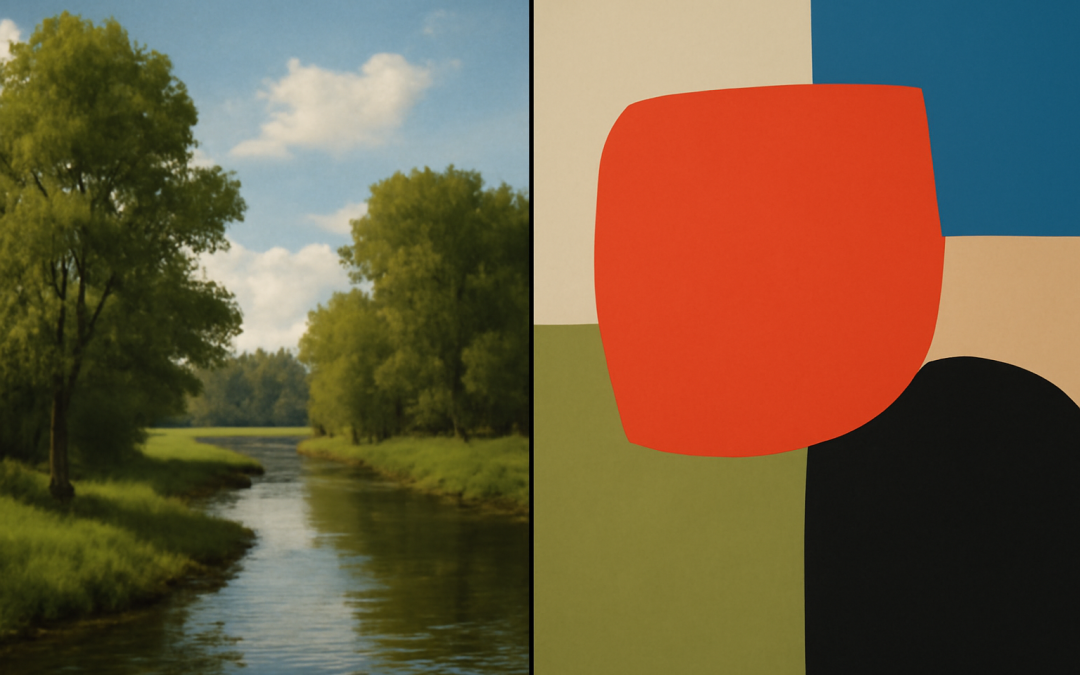
In the realms of art, philosophy, and design, the concepts of representation and abstraction frequently emerge as fundamental approaches to understanding and expressing reality. These two methods serve as distinct yet interconnected strategies for interpreting the world, each offering unique insights and challenges. Representation strives to depict subjects with fidelity to their observable features, aiming to mirror reality as closely as possible. Abstraction, by contrast, deliberately distances itself from the literal appearance, distilling essence, emotion, or conceptual aspects of the subject through symbolic, simplified, or non-literal forms. Understanding the nuanced differences and interplay between these methods enriches our appreciation of creative endeavors and broadens our cognitive engagement with various modes of communication.
Representation is often perceived as the faithful rendering of objects, scenes, or figures as they exist in the tangible world. This approach is deeply rooted in the human impulse to document and preserve the visual and conceptual truths of experience. From prehistoric cave paintings accurate enough to identify animal species, to Renaissance masterpieces teeming with lifelike detail, representational works invite viewers into shared spaces of recognition. These works emphasize clarity and precision, relying on visual cues that resonate with common reality. Through techniques like perspective, shading, and anatomical correctness, representation endeavors to create a believable illusion, guiding observers toward a unified understanding of the subject matter.
This commitment to fidelity does not imply that representational art or thought is devoid of interpretation or creativity. On the contrary, artists and thinkers often employ representation to highlight particular aspects, elicit specific emotions, or convey deeper narratives embedded within literal forms. However, the anchor remains the tangible, the verifiable, and the recognizable. In literature, for instance, representational storytelling hinges on realistic depictions of characters, settings, and events, which ground narratives in believable human experiences. In philosophy, representation can denote the depiction or symbolization of ideas or phenomena in ways that maintain a connection to their original referents in the physical or conceptual realm.
Abstraction, in contrast, breaks from the constraints of direct depiction. It prioritizes form, color, composition, or conceptual content over literal resemblance. The abstract artist or thinker distills experience to its fundamental qualities, aiming to evoke response or insight that transcends mere visual or factual accuracy. Abstraction emerged more prominently in the modern era when shifting cultural paradigms encouraged exploration beyond traditional boundaries. Movements such as Cubism, Abstract Expressionism, and Minimalism embraced the abstract as a means to explore perception, emotion, and the ontological nature of subjects in innovative ways.
The process of abstraction often involves simplification, fragmentation, or symbolic reinterpretation. By deconstructing familiar forms and reassembling them into unfamiliar configurations, abstraction invites viewers or readers to engage actively with meaning-making. It challenges conventional recognition and prompts an inward search for comprehension or connection. Rather than relying on a shared external reality as a guide, abstraction appeals to inner experiences, intellectual curiosity, and subjective interpretation. Its power lies in its universality and ambiguity, enabling diverse readings and emotional resonance regardless of cultural or temporal context.
In visual arts, abstraction can take myriad forms—from geometric shapes and dynamic brush strokes to nuanced color fields and textured surfaces. These elements stand apart from representational content yet communicate through rhythm, balance, and contrast. Similarly, in literature and philosophy, abstraction manifests as allegory, symbolism, metaphor, or theoretical frameworks that separate themselves from concrete particulars to address broader truths or principles. The abstraction in thought probes the essence of an idea, investigating underlying structures or relationships untouched by the distractions of detail.
Despite their seeming opposition, representation and abstraction are not absolute categories but points on a continuum that often overlap and inform one another. Many artworks or philosophies integrate elements of both to enrich complexity. A representational painting may subtly incorporate abstract forms to suggest emotion or movement beyond ordinary sight, while an abstract piece may retain faint traces of recognizable shapes lending it an anchoring reference. This hybridization reflects the inherent tension between capturing the external world and expressing internal realities, a duality central to human creativity.
Beyond the arts and philosophy, the distinction between representation and abstraction plays a pivotal role in domains such as computer science, cognitive psychology, and education. In computer graphics, for instance, representational modeling strives for photorealism, employing algorithms that simulate light, texture, and anatomy to mimic reality. Conversely, abstract modeling seeks simplified data structures or symbolic representations that optimize function or comprehension, like wireframe models or schematics that omit superfluous detail. Similarly, cognitive psychology explores how humans mentally represent information from the environment, balancing concrete sensory inputs with abstract concepts or schemas that facilitate flexible thinking and problem-solving.
In education, understanding the dynamics of representation and abstraction is crucial for effective teaching and learning. Representational techniques are often used to introduce new concepts by grounding them in familiar contexts, making the unfamiliar accessible and understandable. Once foundational knowledge is established, abstraction is introduced to encourage higher-level thinking, critical analysis, and the ability to generalize from specific instances. This graduated approach supports cognitive development and equips learners to navigate complex ideas and systems adeptly.
The philosophical debates around representation and abstraction also engage with fundamental questions about reality, perception, and knowledge. Representational theories of mind, for example, propose that mental states function as stand-ins or models for external reality, enabling interaction and understanding. Critics argue that such views may oversimplify consciousness or neglect the ways in which perception is active, interpretative, and constructed. Abstraction offers alternative perspectives that emphasize the constructive nature of cognition and the fluid boundaries between concept and experience.
Art and philosophy provide fertile ground for exploring how these concepts shape human understanding. Representational art often celebrates the visible world as a shared heritage, reinforcing collective memory and identity. Abstraction, in challenging direct visual or conceptual clarity, can serve as a form of resistance or exploration, questioning assumptions and expanding horizons. The tension between the two encourages dialogue between tradition and innovation, certainty and ambiguity, surface and depth.
Moreover, the tension between representation and abstraction reveals something profound about communication itself. All forms of communication, whether visual, verbal, or symbolic, involve a degree of representation—they stand for something else. Yet, every act of communication also abstracts elements of reality, selecting and shaping them to fit particular purposes, contexts, and audiences. This duality highlights the limits and possibilities inherent in our attempts to convey meaning and truth.
In contemporary culture, this interplay manifests vividly. Advertising often employs representational images to appeal to immediate recognition, while simultaneously incorporating abstract design elements to evoke mood or brand identity. Film and theater blend representational storytelling with abstract symbolism to create layered narratives and emotional depth. Even emerging technologies like virtual reality negotiate representation and abstraction to craft immersive environments that are simultaneously believable and fantastical.
Appreciating the nuances between representation and abstraction enhances critical engagement with art, media, and ideas. It encourages viewers and readers to consider not just what is depicted, but how and why it is presented in certain forms. Questions arise about the artist’s or author’s intention, the cultural context, and the viewer’s own interpretive framework. Recognizing this interplay fosters sophisticated literacy, equipping individuals to navigate a world saturated with images, symbols, and narratives.
In summary, representation and abstraction function as complementary methods for making sense of reality, each serving unique and vital roles in human creativity and cognition. Representation anchors us in a shared, observable world, facilitating recognition, memory, and communication grounded in commonality. Abstraction activates imagination, critical thinking, and emotional depth, inviting engagement with essence and possibility beyond literal constraints. Together, they form a dynamic dialectic that shapes how we perceive, interpret, and express the complex fabric of existence. Embracing the fluid boundary between these approaches opens avenues for deeper understanding and richer expression, illuminating the multifaceted nature of human experience.