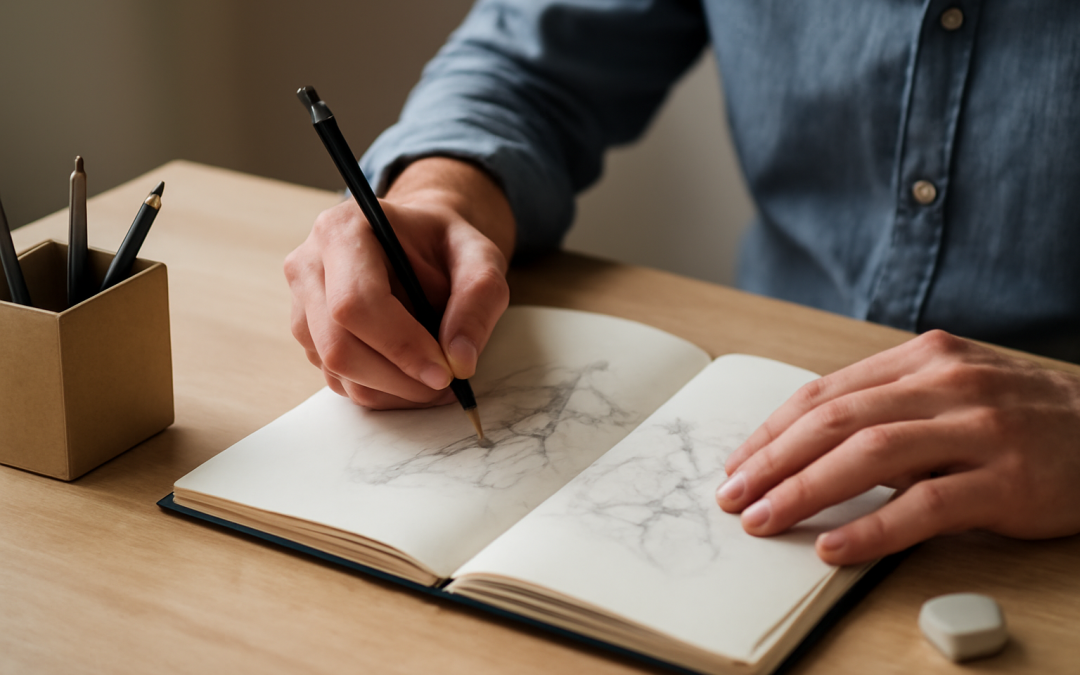
In the midst of complex problem-solving and creative exploration, sketching emerges as more than just a method of visual expression—it becomes a powerful tool for thinking. When words fail to grasp the fluidity of an idea or when mental images remain elusive, sketching serves as an external brain, helping to clarify thoughts and reveal connections that would otherwise remain hidden. This process transforms abstract cognition into tangible form, fostering deeper understanding and innovation.
The act of putting pen to paper initiates a dialogue between the mind and the hand, allowing ideas to unfold in a nonlinear fashion. Unlike verbal thinking, which tends to follow a sequential path, sketching encourages simultaneous consideration of multiple elements and their relationships. This visual form of reasoning taps into our innate ability to interpret shapes, spatial arrangements, and visual metaphors. By externalizing thoughts through sketches, complex concepts become more manageable and open to exploration from different perspectives.
Moreover, the roughness and imperfection inherent in early sketches create a safe space for experimentation. Because sketching does not demand precision or finality, it invites trial and error, encouraging a playful yet purposeful approach to problem-solving. This freedom allows individuals to iterate rapidly, to abandon rigid assumptions, and to embrace evolving ideas. In this sense, sketching acts as a cognitive playground where creativity and analytical thinking coalesce.
Cognitive research underscores the importance of external representations for enhancing memory and problem-solving capabilities. When ideas are captured visually, they become less ephemeral, freeing cognitive resources to focus on higher-level tasks rather than mere retention. Sketching helps organize thoughts and provides a reference to revisit or revise, fostering continuous refinement. It bridges the gap between thought and action, facilitating a more embodied understanding of concepts, which is especially beneficial in fields such as design, engineering, and architecture.
An intrinsic part of this process is the engagement of spatial intelligence—the ability to visualize and manipulate objects mentally. Sketching leverages this skill by transforming intangible concepts into visual forms that can be observed, compared, and modified. This not only supports better comprehension but also enhances communication with others. A sketch can transcend language barriers, conveying ideas with immediacy and clarity that words alone often cannot achieve.
The practice cultivates a mindset that values ambiguity and exploration over premature conclusions. Many breakthroughs arise from moments of uncertainty, where initial sketches capture vague notions that evolve into refined solutions. Embracing sketching as a form of thinking encourages tolerance for complexity and ambiguity, which are often necessary for creative breakthroughs. As sketches develop over time, they accumulate layers of insight and context, documenting the journey of thought in a way that textual descriptions rarely can.
In educational contexts, integrating sketching into learning processes has proven effective for deepening understanding and engagement. Students who sketch during problem-solving or note-taking exhibit improved comprehension and long-term retention. This is partly because the act of sketching activates different neural pathways compared to passive reading or listening, creating a multisensory learning experience. The kinesthetic involvement brakes the cognitive monotony and supports active mental processing, enabling learners to construct meaningful mental models.
In professional environments, the benefits extend beyond individual cognition to collaborative settings. Sketches often function as shared artifacts around which teams can gather and collectively explore ideas. This visual common ground aids in aligning diverse perspectives, reducing misunderstandings, and accelerating decision-making. Whether during brainstorming sessions or design critiques, sketches spark dialogue by making abstract concepts approachable and concrete. Furthermore, the iterative nature of sketching aligns well with agile and dynamic work cultures, embracing flexibility and continuous improvement.
The digital age has expanded the possibilities of sketching, providing tools that enhance traditional methods without eroding the fundamental cognitive benefits. Tablets, styluses, and various software applications enable quick alterations, layering, and sharing of sketches, integrating them smoothly into modern workflows. However, despite these advancements, the tactile experience of hand-drawn sketches on paper retains unique advantages. The direct connection between hand and surface fosters a deeper mental engagement and reduces cognitive friction, underscoring that the medium complements rather than supplants the cognitive function of sketching.
In design disciplines, sketching bridges the gap between imagination and feasibility. By sketching, designers explore form, function, and ergonomics simultaneously, enabling a holistic understanding of potential solutions. This iterative process prevents early fixation on a single idea and promotes divergent thinking, crucial for innovation. Sketching also aids in visualizing spatial relationships, scale, and proportion, elements that might be difficult to grasp purely through verbal description or mental imagery.
Similarly, engineers and scientists utilize sketching to navigate complex systems and abstract phenomena. Diagrams and sketches help isolate variables, map interdependencies, and hypothesize mechanisms. The visual representation can reveal hidden patterns and prompt new questions, fueling scientific inquiry and technological advancement. In this way, sketching becomes a cognitive scaffold, supporting higher-order reasoning and discovery.
Artists and writers also benefit from sketching as a form of thinking, using it to capture fleeting impressions and emotions that later form the foundation of their works. For visual artists, quick sketches serve as memory aids and creative prompts, nurturing the flow of ideas. Writers employ sketching to outline narrative structures, character relationships, or thematic motifs, enriching the storytelling process. Across creative fields, sketching cultivates attentiveness and responsiveness to nuance, deepening the creative dialogue with one’s own mind.
Beyond professional and educational settings, incorporating sketching into everyday life enhances problem-solving and decision-making. When faced with tasks ranging from organizing schedules to planning projects, sketching aids in clarifying priorities and visualizing outcomes. This informal use brings the cognitive benefits of externalization into routine contexts, improving efficiency and reducing mental clutter.
It is important to recognize that sketching, as a thinking tool, does not require artistic talent or aesthetic polish. Its value lies in its capacity to make thinking visible and tangible, not in producing finished artworks. The often messy, provisional nature of sketches reflects the dynamic character of thought itself. Encouraging individuals to embrace imperfection and to view sketches as living documents fosters a mindset of continuous exploration and learning.
The symbiotic relationship between sketching and thinking also emphasizes the importance of slowing down cognitive processes to observe and reflect. In a culture increasingly driven by rapid information flow and digital distractions, sketching offers a moment of pause. It invites mindfulness, promoting deeper insight and clarity. This meditative aspect enhances mental well-being and supports sustained creative engagement.
In summary, engaging in sketching transforms it from a simple act of drawing into a sophisticated cognitive strategy. It serves as a bridge that connects intuition with analysis, imagination with reality, and individual mindsets with collective intelligence. By making thought visible, sketching empowers individuals to navigate the complexities of ideas, fostering innovation, clarity, and collaboration. The integration of sketching into both personal and professional practices holds profound potential for enhancing how we think, learn, and create.