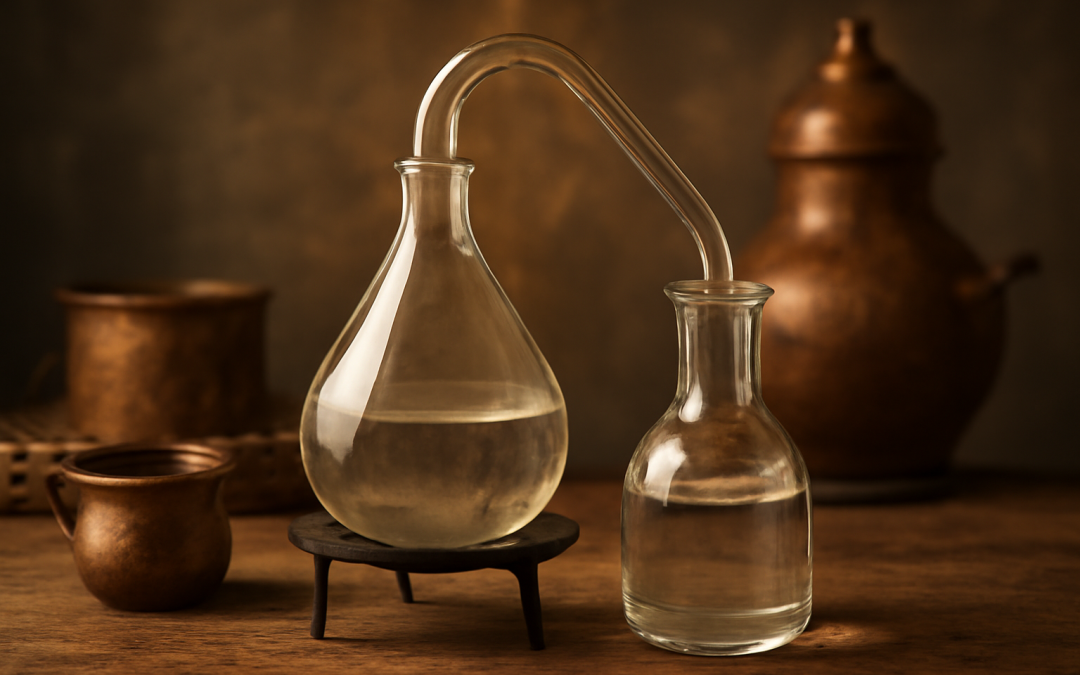
The art and science of distillation have profoundly shaped human civilization, influencing everything from medicine and perfumery to the production of spirits and industrial chemicals. The origins of distillation stretch back thousands of years, weaving through various cultures and epochs, each adding layers of knowledge and refinement to this essential process. Throughout history, distillation has evolved from a rudimentary technique into a sophisticated practice integral to multiple fields, reflecting humanity’s relentless curiosity and ingenuity.
The earliest evidence of distillation can be traced to ancient Mesopotamia around 3000 BCE. Though the precise details remain elusive, archaeological discoveries hint at the use of basic stills for extracting essential oils and perfumes. These early attempts capitalized on the principle that different substances evaporate at distinct temperatures, enabling the separation of liquids. However, the technology was far from perfected, and the primary goal during this period was more about fragrance extraction than creating beverages or medicines.
By the time of the ancient Egyptians, distillation techniques had become more refined. Egyptian records reveal the practice of extracting aromatic waters and essential oils from plants, which were crucial components in medicine, cosmetics, and ritual practices. The Egyptian advancement in glassmaking allowed the development of early forms of alembics—vessels designed to facilitate distillation by condensing vapor back to liquid—showcasing an improvement in apparatus that would influence later cultures. Their work laid an important foundation for both scientific and spiritual applications of distillation.
Significant advancements in distillation technology occurred during the Hellenistic period, particularly with the works of Greek and Roman scholars. The Greek polymath Aristotle and later, Roman authors like Pliny the Elder, mentioned similar processes, though they did not fully understand the mechanisms underlying distillation. More crucially, the pioneering work of Greek alchemists provided a theoretical basis for separating and purifying substances. The confluence of practical invention and theoretical insight during this era helped bridge practical applications with the burgeoning field of natural philosophy.
The real golden age of distillation emerged in the Islamic world during the Middle Ages. Muslim scholars and alchemists like Jabir ibn Hayyan (Geber) revolutionized the craft approximately in the 8th century. Jabir’s writings detailed the construction and operation of the alembic, offering clear guidelines on how to separate liquids based on boiling points. His contributions not only improved the process but also formalized distillation as a scientific technique rather than an artisanal craft. Subsequent scholars in the Islamic Golden Age refined these machines and documented vast knowledge about distillation’s applications in chemistry, pharmacology, and perfumery.
The spread of distillation knowledge from the Islamic world to Europe, largely through Spain and Italy, sparked a transformation in medieval and early Renaissance Europe. Monastic communities played a vital role in maintaining and enhancing the knowledge of distillation. They applied the technique primarily to produce medicinal tinctures and alcoholic beverages, known as aqua vitae or “water of life.” The medicinal use of distilled alcohol eventually laid the groundwork for the production of spirits, which would become economically and culturally significant in Europe over the following centuries.
The late medieval period and Renaissance saw a surge in scientific inquiry, leading to major improvements in distillation equipment and processes. The commercial demand for distilled spirits accelerated innovation, and figures such as Paracelsus contributed to the evolving understanding of the chemical aspects of distillation. The refinement of glassmaking in Europe allowed for more efficient and reliable distillation apparatus, including the introduction of the retort, a device pivotal for heating substances during the process. This period also marked the birth of modern chemistry, with distillation playing a central role in isolating and studying chemical compounds.
By the 17th and 18th centuries, distillation technology had matured and diversified. The Industrial Revolution propelled the mechanization and scaling of distillation operations. New innovations such as the continuous still allowed for larger volumes of distilled liquids with improved purity and efficiency. This era also witnessed the birth of modern spirit industries. The production of whiskey, brandy, rum, and other distilled beverages became commercially significant. The refined distillation techniques enhanced flavor profiles and enabled longer storage, transforming social customs and economies globally.
Simultaneously, distillation extended beyond beverages and perfumes into chemical manufacturing. The ability to purify volatile substances proved critical for the pharmaceutical industry, where the extraction of active ingredients from plants became more precise. Additionally, distillation was essential in producing essential industrial chemicals like ether, acetone, and alcohol for various uses. Scientists like Antoine Lavoisier further clarified distillation’s chemical underpinnings in the 18th century, linking the practice to broader scientific principles of thermodynamics and molecular behavior.
In the 19th and 20th centuries, scientific and technological progress continued to shape distillation’s trajectory. The development of fractional distillation, which involves more precise temperature control and multiple condensations, allowed for the separation of complex mixtures into individual components. This advancement was crucial in the petroleum industry, where crude oil is distilled into fuels, lubricants, and petrochemicals. The invention of laboratory-scale distillation apparatus, such as the Liebig condenser, refined analytical chemistry techniques, facilitating the discovery of new elements and compounds.
Industrial-scale distillation plants became symbols of economic power and technological prowess. Advances in materials science allowed stills and condensers to operate at higher pressures and temperatures, increasing efficiency and safety. The implementation of automation and computer monitoring in the late 20th century further optimized distillation performance, reducing costs and environmental impact. Meanwhile, artisanal distillation persisted, preserving traditional techniques and enabling the craft whiskey, gin, and other spirits’ renaissance observed in recent decades.
Today, distillation remains indispensable across numerous industries. The ongoing innovation focuses on increasing environmental sustainability through energy-efficient designs and alternative heating methods, including solar-powered distillation. The pharmaceutical industry depends on advanced distillation for the purification of delicate compounds, while the food and beverage sectors continually experiment with distillation to create novel experiences. Moreover, environmental applications such as water purification and recycling use distillation processes to address global challenges related to sustainability and resource management.
The historical journey of distillation exemplifies humanity’s capacity to harness nature’s laws, transforming simple observations into powerful technologies. From the ancient extraction of perfumes to high-tech chemical production and spirit distillation, the technique has continuously adapted to meet evolving needs. Each era’s contribution—from rudimentary alembics to modern fractional columns—underscores the cumulative progress that underpins modern science and industry. The story of distillation is not only a chronicle of technological achievement but also a testament to the enduring spirit of creativity and discovery.