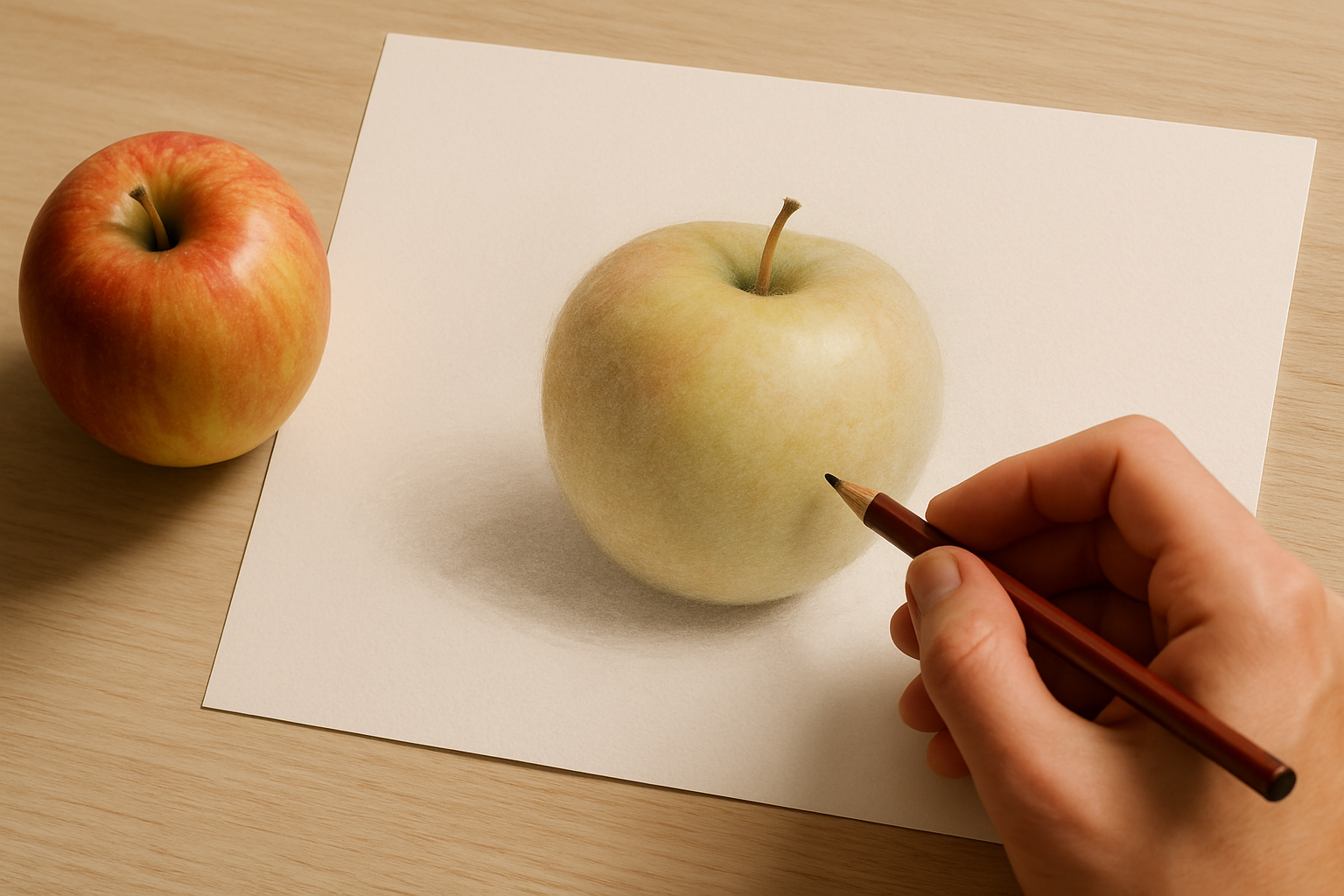
When artists embark on the journey of capturing the essence of their subjects, they often rely on the familiar framework of outlines to define shapes and bring clarity to their work. However, stepping beyond these conventional boundaries opens up a new world of possibilities where form, light, and color interact in more fluid and evocative ways. Drawing without outlines challenges traditional notions of structure and encourages a more subtle and sophisticated approach to depiction. This method not only fosters deeper observation but also enhances an artist’s ability to render volume, texture, and depth through tonal variation and color transitions alone.
At the core of this approach lies the principle of visual suggestion. Instead of delineating objects by their external edges, the artist uses shifts in value, hue, and saturation to imply presence and form. Shadows merge gently into midtones; highlights glow softly against darker patches without the interruption of hard, black lines. This creates a more immersive experience for the viewer, who is invited to engage actively with the image and mentally fill in boundaries. The absence of outlines encourages a focus on the interplay between light and shadow, giving drawings a more painterly and lifelike quality.
One of the key techniques in drawing without outlines involves mastering the contrasts of light and dark. Artists must keenly observe where light falls on their subject and where it recedes, using subtle gradations to model volume. This often requires a stronger reliance on shading techniques—such as blending, layering, cross-hatching, or stippling—with softer transitions replacing the clarity that outlines typically provide. Gradual shifts in tone from light to dark work together to turn two-dimensional surfaces into three-dimensional representations, suggesting contours through value alone.
In color work, the absence of outlines demands even greater sensitivity and control. Color boundaries are allowed to bleed slightly into one another, creating smooth transitions that mirror the way light interacts with surfaces in reality. Utilizing analogous colors and soft edges can enhance the illusion of form, as colors modulate subtly across curves and crevices. Instead of compartmentalizing the composition into discrete shapes, this technique harmonizes every element, allowing the subject to appear as an integrated whole rather than a collection of separate parts.
The practice of drawing without outlines also encourages artists to pay close attention to negative space. When outlines are removed, the spaces around and between objects become crucial in defining their presence. Skillful manipulation of background tones and textures can accentuate the subject’s form and provide context without resorting to explicit boundaries. Negative space becomes an active component in the composition, balancing light and dark and enhancing the overall rhythm and flow of the artwork.
Historical art movements offer valuable insight into this technique. Impressionists, for example, frequently avoided hard edges and defined outlines, opting instead for brushstrokes that suggested rather than delineated. Their works rely heavily on color relationships and light effects to build form, offering vibrant and dynamic scenes that feel spontaneous yet deeply observed. Similarly, many contemporary artists incorporate this approach to evoke mood and atmosphere, using the absence of outlines to create a sense of softness and fluidity often lost in sharply rendered drawings.
For beginners, the transition to drawing without outlines may seem daunting because the safety net of clear edges is removed. It requires confidence in mark-making and a heightened sensitivity to the subtleties of light and shade. A useful exercise is to study objects with simple shapes under strong directional light and practice rendering them through tonal values only. This can help develop an intuitive understanding of how volumes read without relying on contour lines. Gradually, artists can increase complexity, applying these principles to more intricate subjects and diverse textures.
Moreover, drawing without outlines nurtures observation skills in a unique way. Since the artist cannot depend on the conventionally learned contours, there is a necessity to see in terms of form transitions rather than edges. Observing the natural interplay of light on surfaces encourages looking beyond the obvious, noting how one surface blends into another, where subtle shadows define the curve of a cheekbone or the fold of fabric. This intensified observation often leads to more realistic and emotionally resonant work.
Technically, materials play a significant role in successful drawings without outlines. Graphite pencils, charcoal, pastels, and colored pencils each offer different tactile properties that can facilitate smooth gradations and gentle transitions. Soft charcoal is particularly well-suited because of its ability to produce rich shadows and easily blend into light values. Pastels bring the added benefit of vibrant color blending, making them ideal for painters who want to explore form without line. The selection of paper texture also affects outcomes—smoother surfaces encourage seamless transitions, while toothier papers may add texture that contributes to the illusion of detail.
A critical factor in executing drawings without outlines is embracing ambiguity and the power of suggestion. The human brain is remarkably adept at interpreting incomplete visual data; it naturally connects disconnected tonal patches into recognizable forms. This fluidity allows the artist to capture fleeting moments, atmospheric effects, and the essence of movement more convincingly than rigid outlines might. The viewer’s imagination collaborates with the artwork, bringing their own interpretations to the spaces where lines once defined form.
In practical application, this style is particularly effective in portraits and figure drawing, where the subtle shifts of skin tone and the play of light across musculature and bone structures can be rendered with grace and sensitivity. When outlines are omitted, faces take on a softer, more lifelike quality, and expressions become more nuanced. Similarly, fabric and nature studies benefit greatly from this approach, as textures emerge through tonal contrasts rather than defined edges, creating a more organic, integrated look.
Challenges do arise when working without outlines. It can be difficult to maintain clarity and legibility, especially in complex compositions with multiple overlapping elements. Artists must balance softness with sufficient contrast to ensure important forms do not dissolve into the background. Developing a keen eye for hierarchy within the drawing—deciding which areas need sharper delineation through tonal contrast and which deserve subtle blending—is crucial for successful composition.
Ultimately, drawing without outlines is an enriching practice that enhances an artist’s versatility and depth. It encourages reliance on foundational skills such as value control, color modulation, and spatial awareness, while opening new creative possibilities. This approach integrates observation, technique, and interpretation, allowing artists to convey the essence of their subjects in ways that feel both spontaneous and profoundly truthful.
The liberation from outlines invites artists to explore the fluid boundaries between surfaces and space, to trust in the power of light and shadow, and to engage viewers in a more intimate, collaborative visual experience. It transforms drawing from a mere act of replication into a nuanced language of suggestion and perception, where each stroke and gradient resonates with meaning beyond the physical mark on paper. In doing so, it redefines not only the act of drawing but also the relationship between artist, subject, and observer.