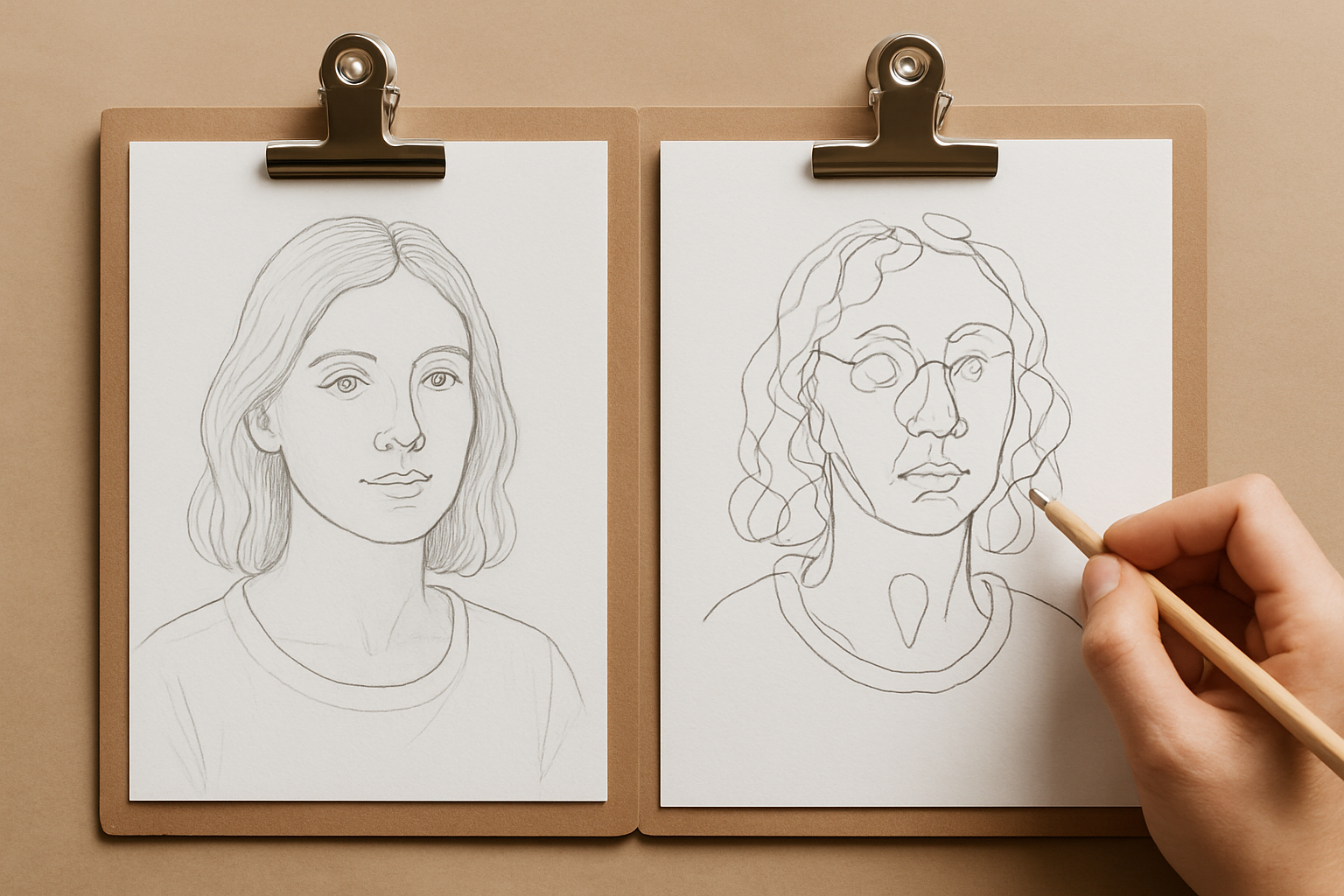
Drawing is a discipline that demands both technical skill and a profound understanding of observation. Among the myriad techniques artists employ to sharpen their abilities, contour and blind contour drawing are often introduced early in artistic training for their unique approaches to seeing and representing the subject. These methods focus deeply on the artist’s perception and hand-to-eye coordination, yet they differ significantly in execution, intention, and outcome. Exploring these two techniques reveals not only their individual merits but also how they complement each other in artistic development.
Contour drawing, in its traditional sense, involves carefully outlining the visible edges and outlines of a subject. This method trains the artist to observe the subtle details that define the object’s form, such as curves, textures, and boundary lines, and to translate these observations onto paper. The artist’s gaze typically alternates between the subject and the drawing surface, allowing for adjustments to be made to maintain accuracy and proportion. This interplay between observation and drawing helps to build a precise understanding of the subject’s spatial relationships and dimensions. Artists appreciate contour drawing for its ability to capture structural integrity and detail, which is vital for realistic representation.
On the other hand, blind contour drawing strips away many of these corrective steps. In a blind contour exercise, the artist draws the contours of the subject without looking at the paper once the pencil touches the drawing surface. The eyes remain focused strictly on the subject, forcing the hand to keep pace with the constant observation of form without visual verification of the marks being made. This method challenges the artist’s ability to truly observe and replicate shapes without the interference of preconceptions or the tendency to self-correct for accuracy. As a result, blind contour drawings often look abstract and unconventional, emphasizing the process of seeing over the product itself.
Both contour and blind contour practices are instrumental in enhancing visual perception and hand-eye coordination but achieve these benefits through different pathways. Contour drawing encourages control and careful observation, reinforcing the habit of looking closely at edges, overlaps, and intricate details. It highlights structural relationships and fosters a precise and deliberate style, making it highly beneficial for artists aiming to create representational work with realism. By contrast, blind contour drawing is more about developing the skill of deep observation, where the visual connection between the eye and the hand becomes paramount. It deters the reliance on preconceived shapes and encourages authentic, unfiltered interpretation, often unveiling fresh and surprising perspectives on the subject.
The origins of contour drawing trace back centuries and have been a fundamental element in art education worldwide. The practice was notably championed by artists and educators who believed that focusing on the subject’s outline helped beginners cultivate an accurate perception of form before moving on to shading and more complex elements. Blind contour, as a technique, gained prominence through the teachings of modern art instructors who sought to shatter students’ fear of imperfect drawing. By encouraging students to maintain rigorous observation without the pressure of visual self-critique, blind contour exercises cultivate an environment conducive to growth, experimentation, and creativity.
In practical application, contour drawing serves as a foundation for many styles of visual art. It supports the development of meaningful sketching skills, gesture drawing, and even preparatory work for painting. Because of its emphasis on detail and proportional accuracy, many artists rely on contour studies to better understand their subjects before moving to more complex stages of their artwork. Furthermore, contour drawings can stand on their own as finished pieces, celebrated for their clarity and elegance. The use of continuous or broken lines in contour drawing can create a dynamic and refined representation of the subject, emphasizing both form and the artist’s hand.
Blind contour drawing, while less concerned with polished outcomes, has a crucial role in artistic exploration and creative expression. The looseness and unpredictability of blind contour sketches reveal the artist’s response to the subject in a raw and visceral way. Often, these drawings feel spontaneous and animated, capturing a sense of movement and life that controlled contour work might not express. This technique is highly valued for breaking down mental barriers that convince artists to strive for perfection prematurely. By removing the ability to monitor the drawing visually, artists learn to trust their observation and the direct connection between seeing and mark-making.
Interestingly, the psychological benefits attached to these techniques also distinguish them. Contour drawing encourages mindfulness and patience, as the artist methodically studies the subject and transfers those observations slow and steady onto paper. This meditative quality hones concentration and calm deliberate focus, skills that are transferable across all forms of visual art. Blind contour drawing, in contrast, is often associated with playfulness and experimentation. It invites artists to embrace mistakes, fostering a growth mindset where imperfection is seen as a natural and valuable part of learning rather than a flaw. This can be particularly freeing and invigorating for beginners intimidated by traditional expectations of artistic precision.
Artists working in a variety of media and styles find both contour and blind contour drawing serve complementary purposes. For instance, a portrait artist might begin with contour studies to lock down the basic planes and proportions of the face before executing a more detailed and refined piece. Concurrently, engaging in blind contour drawing exercises can help that same artist develop a keener sensitivity to the nuances of facial structure and expression. Similarly, landscape artists may use contour drawing to capture delicate edges and transitions between natural forms, while blind contour practice can enhance their ability to instinctively respond to the overall movement and rhythm of the scene.
Educational programs often integrate these two styles to maximize their benefits. Beginners first learn contour drawing to build foundational skills in observation and line control. Later, blind contour exercises are used to challenge their reliance on visual feedback and boost intuitive drawing skills. This pedagogical approach fosters a balanced development of technical skill and creative freedom. It encourages students to see drawing as an ongoing dialogue between observation and expression, rather than just a quest for photographic accuracy. Instructors also find blind contour invaluable for loosening up stiff and self-critical artists, helping them rediscover the joy of spontaneous mark-making.
From a technical perspective, the tools used for contour and blind contour drawing don’t differ significantly, but the approach to these tools does. Artists typically use a pencil, pen, or fine liner for contour drawings to maintain controlled, clean lines that capture the subject’s edges clearly. In contrast, blind contour work often makes use of more fluid media that accommodate swift, continuous lines without the need for erasing or corrections. Some artists even employ digital tablets to practice these techniques, benefiting from the immediacy and ease of experimenting with lines that can be quickly reset or adjusted without pressure.
An intriguing consideration lies in how these two techniques influence an artist’s style over time. Artists devoted to contour drawing tend to develop work characterized by precision, clarity, and an emphasis on representation. Their drawings often reflect a structured approach and are valued for their meticulous craftsmanship. Conversely, artists who frequently incorporate blind contour methods might develop a looser, more gestural style, where abstraction and expressive lines play a central role. Many contemporary artists embrace the fluidity of blind contour drawing to capture essence and emotion rather than literal depiction.
These differences also extend into how each technique contributes to artistic problem-solving. When an artist faces challenges with proportion or composition, contour drawing provides a reliable framework for carefully analyzing and correcting inaccuracies. It functions as a diagnostic tool that lays down the structural groundwork before color, shading, or other embellishments are added. Blind contour drawing, while less structured, serves as an exercise to push beyond conventional visual assumptions. It can lead to unexpected insights by disrupting habitual ways of seeing and encouraging novel interpretations, thus expanding an artist’s creative repertoire.
Over time, many artists find that integrating both contour and blind contour drawing into their practice yields the greatest benefits. The combination nurtures a richer, fuller relationship with the act of seeing and drawing. An artist can sharpen technical skills and knowledge of form through contour drawing, then turn to blind contour to harness spontaneity and fresh visual habits. This interplay creates a dynamic feedback loop where observation and intuition reinforce one another, ultimately leading to a more confident and versatile artistic practice.
Finally, the distinction between contour and blind contour drawing echoes a broader philosophical divide in art—the tension between control and freedom, order and chaos, accuracy and expression. Contour drawing aligns with the pursuit of mastery, where careful observation and deliberate execution aim to replicate visual reality. Blind contour drawing champions discovery, chance, and the subjective voice of the artist. Both approaches honor the fundamental act of seeing but invite the artist to engage with that process in remarkably different ways. Recognizing and appreciating this duality enriches the journey of learning to draw and deepens the artist’s connection to their craft.
In conclusion, exploring the nuances between contour and blind contour drawing reveals how each technique serves as a vital stepping stone in the development of an artist’s observation and drawing skills. While contour drawing offers a disciplined pathway to visual accuracy and technical confidence, blind contour drawing frees the artist to experiment, trust instinct, and see with fresh eyes. Rather than viewing these techniques as competing methods, understanding their unique contributions encourages artists of all levels to incorporate both into their practice, reaping the rewards of improved perception, increased creativity, and a more profound engagement with their subjects. Mastery comes not from choosing one over the other, but from harmonizing their strengths to enrich the timeless process of drawing.