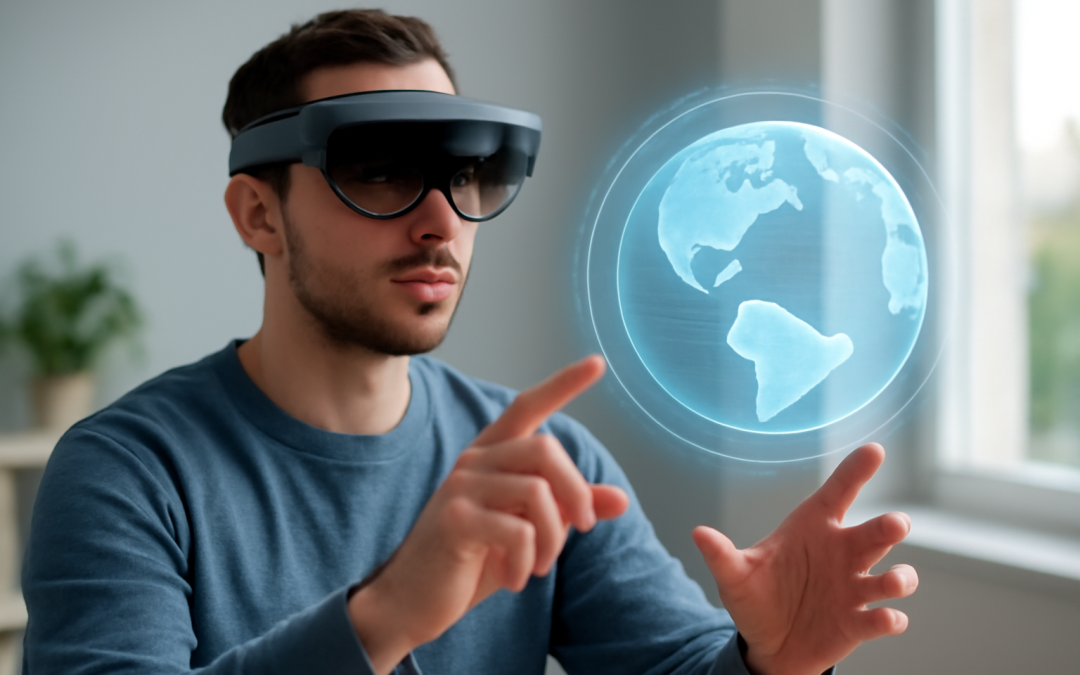
Augmented reality is a technology that seamlessly blends the digital world with the physical one, enhancing how people perceive and interact with their surroundings. Unlike virtual reality, which immerses users entirely in a computer-generated environment, augmented reality overlays digital information onto real-world objects, enriching everyday experiences without disconnecting from reality. This integration allows for a dynamic and interactive interface, transforming how information is delivered, received, and engaged with across various contexts.
The foundation of augmented reality lies in its ability to superimpose computer-generated visuals, sounds, or other sensory stimuli onto the user’s view of the real world in real-time. Devices such as smartphones, tablets, AR glasses, and headsets serve as the mediums through which these enhancements are viewed. The technology relies on a combination of sensors, cameras, GPS, and advanced algorithms to accurately detect the physical environment and position digital content accordingly. This capability enables applications that range from navigation assistance and educational tools to gaming and industrial design.
One of the most familiar implementations of augmented reality can be found in mobile applications where the camera captures the live environment and the software adds virtual objects that appear to coexist with the physical space. For example, AR apps in retail allow users to visualize furniture or home decor items within their actual rooms before making a purchase decision. This practical use empowers consumers to make more informed choices by bridging the gap between imagination and reality.
In entertainment and gaming, augmented reality has revolutionized the way users interact with digital content. Games that encourage players to explore their surroundings, find virtual creatures, or engage in battles superimposed onto the real world have gained immense popularity. By merging gameplay with physical spaces, AR creates immersive experiences that motivate movement and social interaction, differentiating it significantly from traditional screen-based gaming.
Beyond consumer applications, augmented reality holds profound implications for industries such as healthcare, manufacturing, and education. Medical professionals use AR to visualize complex anatomical structures during surgeries, enhancing precision and outcomes. In manufacturing, AR can provide real-time assembly instructions overlaid on machinery, reducing errors and training time. Educational institutions integrate AR to offer interactive learning experiences, where historical events or scientific phenomena are vividly brought to life in classrooms, improving comprehension and retention.
The technological ecosystem driving augmented reality is composed of various key components. Tracking systems are vital for determining the user’s position and orientation in space to ensure digital elements align correctly with the real world. Depth sensors and cameras collect environmental data, while processing units analyze this data to render accurate and responsive content. Displays then present the combined real and virtual imagery to the user, whether through transparent lenses in glasses or screens on mobile devices. Advances in hardware miniaturization and software sophistication continue to make these systems more efficient and accessible.
Software development plays an equally crucial role in crafting compelling augmented reality experiences. Developers use specialized AR development kits and platforms to design applications capable of recognizing surfaces, understanding context, and responding to user inputs naturally. Machine learning algorithms increasingly enhance AR by enabling devices to better interpret complex scenes and anticipate user behavior. This level of interaction promotes a more intuitive and personalized experience that reflects actual needs and preferences.
One of the challenges facing augmented reality technology has been achieving seamless integration without compromising user comfort or convenience. Early AR devices were often bulky and limited by processing power or battery life, constraining their practical deployment. However, rapid advancements have led to lighter, more ergonomic designs with improved energy efficiency, enabling longer use periods and expanding the range of environments where AR can be effectively utilized.
Privacy and security concerns are also critical considerations as augmented reality grows in adoption. Since AR devices frequently collect and analyze real-world data, including personal and environmental information, ensuring that this data is handled responsibly is paramount. Developers and companies must adhere to stringent policies that protect user privacy while still enabling the functionality necessary for meaningful AR applications. The balance between innovation and ethical obligation is an ongoing dialogue within the AR community.
Augmented reality continues to evolve as its capabilities become increasingly sophisticated and intrinsic to daily life. The future promises greater convergence with other emerging technologies such as artificial intelligence, 5G connectivity, and the Internet of Things. These intersections are expected to propel AR beyond stand-alone applications towards integrated ecosystems where digital and physical realities interact fluidly across various platforms and environments.
In commerce, AR-powered virtual try-ons, personalized promotions, and interactive product demonstrations are setting new standards for customer engagement. Retailers can offer immersive experiences that not only drive sales but also foster brand loyalty through tailored content and gamified interactions. This consumer-centric approach underscores the transformative potential of augmented reality in reshaping how products and services are marketed and consumed.
Similarly, urban planning and tourism sectors are exploring AR to revitalize spaces and storytelling. Visitors can use AR-guided tours that provide historical context, translate signage, or offer virtual reconstructions of ancient architecture at heritage sites. City planners benefit from AR tools that overlay proposed developments onto real landscapes, facilitating better decision-making and community involvement through visual simulations.
Education stands to gain immensely from the enriched interactivity afforded by augmented reality. Students can dissect virtual organisms, manipulate 3D models, or participate in collaborative projects where digital information complements hands-on learning. AR can help bridge gaps caused by remote education or resource limitations by providing accessible, engaging content that adapts to various learning styles and disciplines.
In healthcare, augmented reality’s influence extends beyond surgery into rehabilitation, mental health, and patient education. Therapists employ AR-based exercises to promote motor skills recovery, while immersive environments help manage anxiety and phobias through controlled exposure therapy. Patients benefit from visualization tools that improve understanding of their conditions and treatment plans, empowering them to take an active role in their care.
Industrial applications of augmented reality also emphasize innovation and efficiency. Maintenance workers use AR glasses to receive step-by-step guidance without needing to consult manuals, drastically reducing downtime. In logistics, AR supports warehouse management by optimizing item location and retrieval through smart overlays. The ability to access pertinent data hands-free in complex environments exemplifies the practical utility of augmented reality in boosting productivity and safety.
As the technology advances, the integration of AR with emerging systems such as wearable devices and smart environments deepens its impact. Future AR experiences may leverage biometric sensors to tailor content based on user emotions or physical state, creating responsive environments that adapt dynamically. The blending of AR with cloud computing and edge processing will enable real-time interactions at unprecedented scales and speeds, broadening the scope of possibilities.
Despite these promising developments, several hurdles remain in broadening augmented reality accessibility and adoption. Cost, technical complexity, and user acceptance vary widely across demographics and use cases. Addressing these challenges requires interdisciplinary collaboration among technologists, designers, policymakers, and end-users to ensure that augmented reality fulfills its potential as a tool for empowerment, creativity, and connection.
Standardization and interoperability also play crucial roles in shaping the future of augmented reality. Establishing common protocols and open platforms can promote innovation by enabling diverse applications and devices to work together harmoniously. Such efforts encourage an inclusive ecosystem where new ideas flourish without being hindered by proprietary constraints or fragmented experiences.
Ultimately, augmented reality represents a transformative leap in how information is contextualized and utilized. By bridging digital and physical realms, it fosters deeper engagement and understanding that transcend traditional media formats. Its ability to augment perception and interaction has profound implications not only for individual users but also for society as a whole, reshaping education, commerce, healthcare, and entertainment in ways that were once the domain of imagination.
In conclusion, the technology has already begun to permeate a multitude of facets of everyday life, and its trajectory points toward even more integrated and sophisticated applications. As it matures, augmented reality is set to redefine human-computer interaction by creating environments that are simultaneously informative, immersive, and intuitive. Embracing this technology opens the door to novel experiences and opportunities that enhance human potential while fostering connectivity with the world around us.