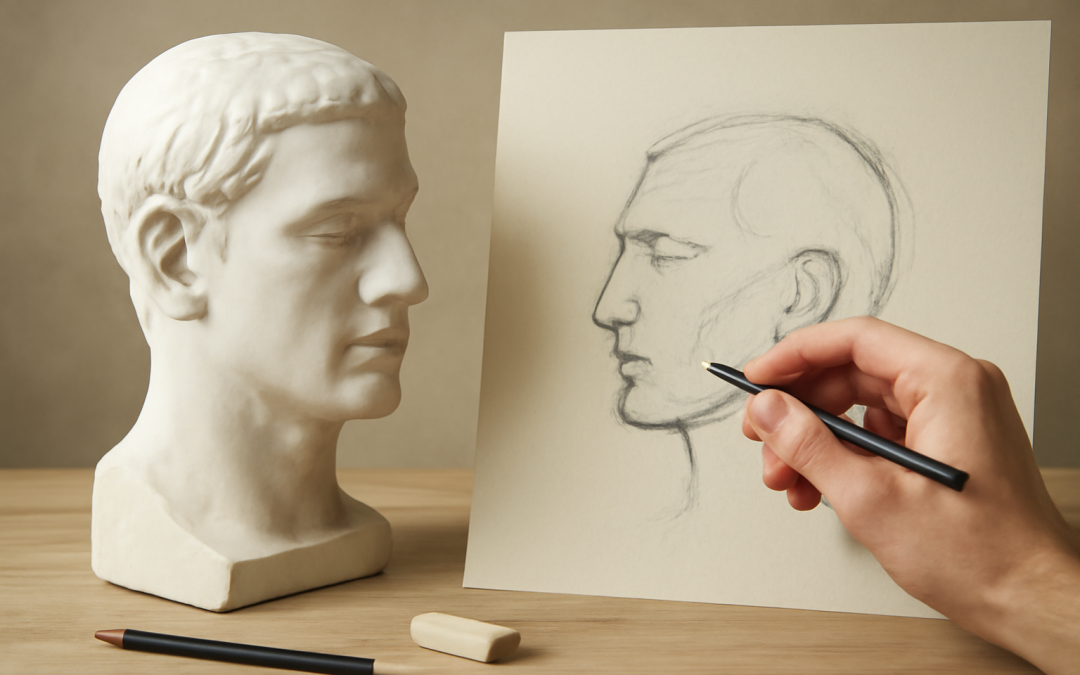
When painters and illustrators approach their work, they often think in terms of flat surfaces, using lines, colors, and forms within the two-dimensional plane of paper or canvas. However, integrating sculptural thinking into this process can profoundly transform the way artists perceive and depict their subjects. Sculptural thinking encourages artists to consider weight, volume, mass, and spatial relationships as if the forms they create could be touched and felt in three dimensions. This mindset shifts the creative process beyond mere representation toward an experience that bridges flat imagery and tactile reality.
At the core of sculptural thinking lies an enhanced understanding of form as something that exists not only on a picture plane but also within space and mass. Even in two-dimensional work, artists can evoke a convincing sense of weight and balance that mimics physical phenomena. This requires a mental leap: imagining how the shapes constructed on a canvas would respond to gravity, tension, and pressure if they were tangible objects. When artists adopt this perspective, their work gains a structural integrity and presence that goes beyond flatness, offering viewers a sense of life and dynamism rooted in real-world physics.
One way to cultivate sculptural thinking in flat artwork is by closely studying actual sculptures, whether classical statues, modern abstract forms, or natural objects like bones and rocks. When viewing these three-dimensional forms, artists can observe how light falls across surfaces, how contours curve and taper, and how negative space interacts with solid matter. These observations can then be translated into carefully constructed shading, gradients, and overlapping shapes in drawings or paintings. By interpreting the dynamics of physical volume and texture, artists breathe convincing dimensionality into their compositions.
Additionally, understanding anatomy from a sculptural perspective greatly benefits those who draw figures. Muscles bulge, bones project, and skin stretches in response to movement and weight distribution. Rather than depicting the figure as a flat outline with surface details, sculptural thinking pushes artists to model the figure’s form from the inside out. This involves breaking down the human body into simplified geometric volumes—cylinders for limbs, spheres for joints, and boxes for the torso—to ascertain how these shapes relate spatially and support one another. Such structural insight fosters drawings that feel poised and tangible rather than stiff or superficial.
The concept of negative space, so vital in sculpture, also holds immense value for flat artists. Negative space refers to the empty or unoccupied areas surrounding forms. In three dimensions, these spaces affect how a sculpture reads and how its elements connect in the viewer’s perception. For painters and illustrators, awareness of negative space can guide composition, balance, and visual flow. Seeing beyond the figure to the shapes that surround it allows for more harmonious layouts and encourages interplay between elements, promoting a unified whole rather than isolated parts.
Light and shadow are other crucial tools in sculptural thinking applied to flat media. Shade reveals form, creating illusions of depth and volume. By understanding how light interacts with three-dimensional objects, artists can skillfully apply highlights and cast shadows to suggest curves, recesses, and protrusions. This approach is more than just adding darkness to light areas—it involves mimicking the subtle gradations of light wrapping around a form and adjusting its intensity according to the imagined surface texture and contour. This refined use of light and shade evokes the tactile presence of mass.
Perspective and spatial relationships also benefit from sculptural thinking. Artists who typically rely on standard one-point or two-point perspective can deepen their spatial rendering by considering objects as occupying volume with thickness and depth. This often means challenging the flat picture plane and visualizing forms rotating or extending into space, changing how their edges and surfaces present to the viewer. Incorporating foreshortening, overlapping volumes, and shifting viewpoints enriches the image’s realism and complexity, immersing viewers in an apparently solid world rather than a mere flat depiction.
Experimenting with mixed media and materials can further reinforce sculptural concepts in flat work. Combining thick impasto paint textures, layered papers, or textured mediums allows painters to build a sense of surface relief, simulating the physicality of sculpture. These tactile components invite both artists and viewers to engage with the artwork beyond visual perception, attuning their senses to dimension and materiality. At the same time, these literal textures merge with the illusionistic shading and modeling typical of two-dimensional representation to create a balanced tension between real and implied form.
Sculptural thinking encourages artists to break free from purely decorative or pattern-based approaches, urging them instead to see every element as a part of a coherent physical system. This mindset shifts the focus from mere visual allure to structural authenticity, fostering a deeper emotional and intellectual connection between the work and its audience. When an image feels physically plausible, it resonates intuitively, generating a sense of presence that engages viewers on multiple levels. The artwork, though flat, becomes a kind of mental sculpture shaped through perceptual cues.
Developing this way of thinking requires patience and continuous practice. Artists might begin by sculpting clay models of their subjects or using 3D modeling software to gain hands-on experience with form and volume. This tangible involvement strengthens spatial intuition and makes translating three-dimensional observations into two-dimensional marks more fluid and confident. Sketching objects from multiple angles, experimenting with light setups, and creating tonal studies are practical exercises that deepen an artist’s sculptural awareness and improve the execution of flat work.
Moreover, adopting sculptural thinking enhances versatility, enabling artists to navigate effortlessly between different artistic disciplines. An artist fluent in the language of volume and spatial relations may find it easier to collaborate with sculptors, stage lighting for theater, or engage in animation and graphic design, where three-dimensionality often informs movement and composition. This cross-pollination of skills strengthens creative problem-solving and enriches artistic vocabulary, pushing boundaries beyond the constraints of flat media.
Importantly, integrating sculptural thinking need not diminish the unique strengths and qualities of two-dimensional art. Flat artists can maintain the immediacy, clarity, and graphic impact of their work while imbuing it with a robust, volumetric foundation. This blend encourages experimentation that respects flatness as an essential characteristic rather than a limitation. The interplay between surface and depth, light and shadow, positive and negative space invigorates flat artwork with dimensional complexity without sacrificing its inherent expressiveness.
In teaching environments, incorporating sculptural thinking into curricula equips students with a holistic understanding of form, fostering conceptual and technical growth. When educators guide students to perceive and construct shapes as physical entities rather than arbitrary lines or shapes, they lay groundwork that is transferable across genres and styles. Students gain confidence in their ability to depict believable, dynamic forms, boosting their creative autonomy and breadth of expression.
This approach also aligns well with contemporary trends emphasizing interdisciplinary explorations and hybrid art practices. As visual culture evolves, artists who master the interplay between flatness and volume are uniquely positioned to innovate and redefine artistic boundaries. Sculptural thinking opens pathways toward more immersive, multi-sensory experiences in visual art, enriching cultural expression in an increasingly complex creative landscape.
Ultimately, adopting sculptural thinking transforms the artist’s relationship with their medium and subject. It cultivates a deeper sensitivity to the physical world, fostering artwork that resonates with tangible presence and enduring vitality. For flat artists willing to explore this mode of perception, the result is a richer, more compelling visual language that bridges surface and space, imagination and reality, flatness and form. This synthesis invites both creators and viewers to see beyond the plane into the heart of shape itself, opening a world of artistic possibility.